Voices Before They're Gone: Albanian-American Youth Race to Rescue the Heroic Epics of Their Grandparents
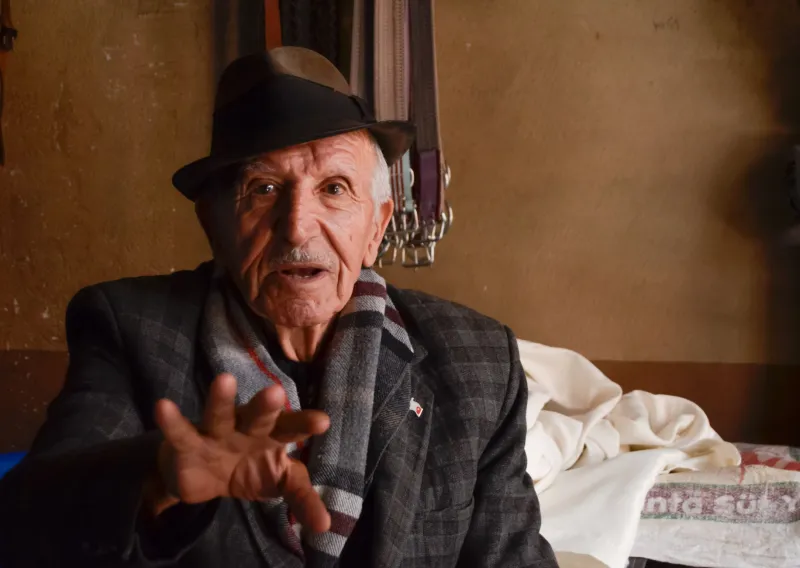
Ejona Hoxha was twenty-two years old the first time she really listened to her grandfather sing. Not the humming he did over coffee, not the half-verses he'd mutter watching soccer — she means listened. Sat across from him at his kitchen table in the Bronx with her phone propped against a coffee mug, recording.
"He started with this epic about Skanderbeg," she says, "and I realized I had no idea what he was actually saying. I understood the words, sort of. But I didn't know the story. I didn't know why he was crying by the end of it."
That afternoon became the seed of what is now a small but growing oral history project she runs with friends in New York, collecting traditional Albanian heroic narratives — the këngë e kujtesës, or songs of memory — from elderly community members before those voices disappear entirely.
Ejona isn't alone. From Michigan to Massachusetts, from the Albanian enclaves of the Bronx to the suburbs of New Jersey, young diaspora members are launching their own versions of the same urgent project. They're building digital archives, producing podcasts in both Shqip and English, and staging community events where these epics get performed live, sometimes for the first time in decades on American soil.
What Exactly Are These Epics?
For anyone who didn't grow up in an Albanian household, a quick primer: the këngë e kujtesës aren't just folk songs. They're a living archive. Passed down orally for generations — often by traveling bards called lahutarë who played a single-stringed instrument called the lahuta — these epics carried the history, grief, and defiance of a people who spent centuries under Ottoman rule and then decades under communist repression.
Think of them as Albania's answer to Homer. Some of these narratives are genuinely ancient, tied to the same Indo-European oral tradition that produced the Iliad. Others are more recent, commemorating 19th-century nationalist heroes or mourning villages lost to war and forced migration. What connects them all is the way they were kept alive: not in books, not in classrooms, but in the mouths of ordinary people.
The problem is that communist Albania actively suppressed much of this tradition, associating it with religion, feudalism, or dangerous nationalism depending on the era. And in the diaspora, the chaos of immigration — the pressure to assimilate, the sheer exhaustion of building a new life — meant that many families simply never passed these stories on.
Which means the generation that does carry them is aging fast.
The Race Against Time
"My grandmother is eighty-four," says Ardit Leka, a twenty-six-year-old based in Worcester, Massachusetts, who started his own recording project two years ago. "She knows songs that nobody has written down anywhere. When I finally asked her to sing them for me, she looked at me like I'd asked her to fly. She said, 'Who taught you to care about that?'"
That question — who taught you to care — cuts right to the heart of what these young archivists are doing. Most of them grew up in households where Albanian identity was expressed through food, through family loyalty, through maybe a flag on the wall. The deeper cultural inheritance — the oral literature, the historical memory, the why behind the traditions — often got lost in translation. Literally.
So these projects aren't just documentation efforts. They're acts of self-education happening in real time. Ejona describes spending hours after each recording session cross-referencing what her grandfather sang with academic papers on Albanian oral tradition. Ardit has been teaching himself to read old Gheg Albanian dialect so he can better understand what he's capturing.
"I feel like an archaeologist sometimes," he says, laughing. "Except the artifacts are still alive and they make me tea."
From Tape Recorder to TikTok (Sort Of)
The question of what to do with these recordings is where things get genuinely interesting — and a little contentious.
Some projects are deliberately lo-fi and community-facing. A group in the Bronx hosts monthly listening nights where recordings are played and discussed, with older community members helping younger ones understand the context. It's intimate, almost liturgical. The goal isn't reach — it's depth.
Others are going broader. A podcast called Zëri i Paraardhësve (Voice of the Ancestors), launched last year by a trio of Albanian-American college students, releases bilingual episodes that pair recorded epics with conversational breakdowns for listeners who don't speak Shqip fluently. Their episode on the Battle of Kosovo epic drew a few thousand listeners — modest by podcast standards, but significant for a niche Albanian-American cultural project.
Then there's the question of performance. Several community theaters in New York and New Jersey have started incorporating oral epic recitation into cultural events, sometimes with musical accompaniment, sometimes as spoken word. The results can be electric — and occasionally awkward, as performers navigate the tension between theatrical interpretation and ethnographic fidelity.
"Some of the elders in the community get upset when you change anything," admits Rina Gjoka, a theater director in Astoria who has staged two such performances. "And I understand that. But if I perform it exactly as it was sung in 1950s rural Albania, and nobody in the audience under forty connects with it, what have I actually preserved?"
The Authenticity Debate
This tension — preservation versus relevance — is the central argument running through all of these projects, and it doesn't have a clean resolution.
On one side are the purists, mostly older community members and some academics, who worry that adapting these epics for Gen Z audiences risks flattening their complexity or stripping away the very cultural specificity that makes them valuable. The këngë e kujtesës aren't just stories — they encode specific historical events, specific regional identities, specific moral frameworks. Translating them too freely risks turning them into Albanian-flavored content rather than genuine cultural transmission.
On the other side are the young archivists themselves, many of whom argue that a perfectly preserved epic nobody listens to is already dead. "My cousin is seventeen," says Ejona. "She's not going to sit through a forty-minute lahuta recitation in Gheg dialect with no context. But she might watch a fifteen-minute video where I explain what the epic is about and then play a clip of my grandfather singing it. That's a door. I'm just trying to build doors."
What's striking is that the elders being recorded often land somewhere in the middle. Many of them are thrilled — genuinely moved — that anyone wants to hear these songs at all. More than one has told their young interviewers that they'd given up hope anyone in the family would ever ask.
Why It Matters Here, in America
There's something specifically American about this moment. The Albanian diaspora in the US is large enough to sustain its own cultural institutions, but fragmented enough — spread across cities, split between different regional origins, divided by generation and class — that shared cultural memory is hard to maintain.
Oral epics, it turns out, are surprisingly good at bridging some of those gaps. They carry a kind of emotional authority that no history textbook can replicate. When Ardit plays his grandmother's recordings at community events in Worcester, he says something shifts in the room.
"People who came from completely different parts of Albania, people who didn't grow up speaking the same dialect — they all recognize something in it. It's like... it's the same signal, even if the frequency is different."
That's the bet these young archivists are making. That the këngë e kujtesës, even translated and adapted and packaged for American ears, still carry something essential. Something worth racing to save.
The recording light is blinking. The grandparents are still here.
For now.