Byrek Meets Brooklyn: How Young Albanian-Americans Are Cooking Up a New Food Identity
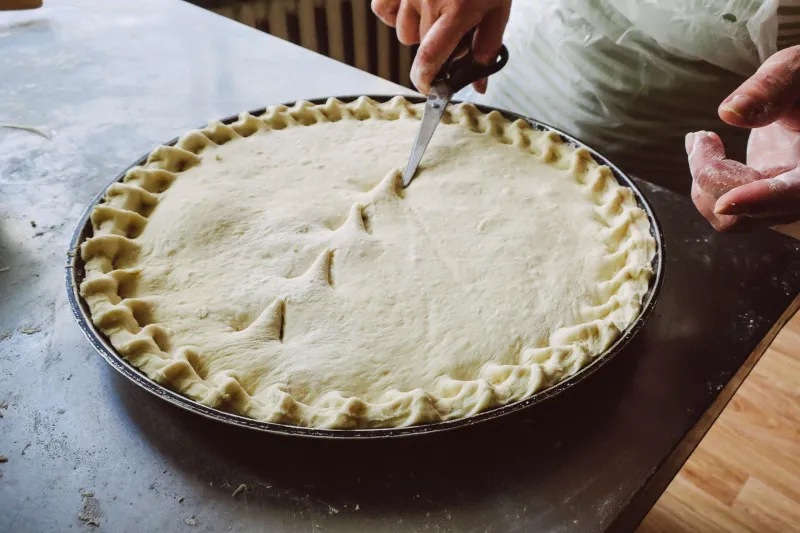
There's a moment that almost every second-generation Albanian-American knows. You're at school lunch, you've got a container of tavë kosi or a slice of byrek your mom packed that morning, and your classmates are staring at it like it landed from another planet. You either learn to laugh it off, or you quietly wish you had a PB&J instead.
Fast forward twenty years, and that same kid might be running a food blog with 40,000 followers, or plating a deconstructed fërgesë at a farm-to-table spot in Portland. The Albanian-American kitchen is having a moment — and it's long overdue.
The Grandma Problem (And Why It's Actually a Gift)
Ask any Albanian-American cook where they learned to cook, and nine times out of ten, the answer involves a grandmother, a wood-burning stove, and absolutely no written recipe. That's both the beauty and the challenge of Albanian culinary tradition. It lives in muscle memory, in smell, in the way your gjyshja could tell the burek was ready without ever looking at a timer.
"My grandmother never measured anything," says Erinda Hoxha, a home cook and food content creator based in the Bronx who goes by @EriCooks on Instagram. "She'd just say 'enough flour' or 'cook it until it smells right.' Translating that into something I could actually teach my American-born niece took me years."
Erinda started documenting her cooking journey during the pandemic, initially just for family. Now she posts bilingual recipe videos — Albanian and English — that pull in viewers from as far as Australia and Kosovo. Her most-watched video? A byrek me spinaq made with store-bought phyllo dough from Trader Joe's. "I got some grief from purists," she laughs, "but also thousands of comments from people saying 'I finally made it and it worked.' That's the win."
Restaurant Row, Albanian Edition
Beyond the home kitchen, a small but growing number of Albanian-American chefs are making their mark in the restaurant world. In New York, Chicago, and Detroit — cities with established Albanian diaspora communities — you can find spots that go beyond the standard Mediterranean menu to offer something more specifically Albanian.
In the Belmont neighborhood of the Bronx, a tight-knit area sometimes called "Little Albania," restaurants like Sofra and Dua have been serving the community for years. But newer establishments are experimenting with format. Think Albanian street food pop-ups, catering companies specializing in qofte sliders for American backyard parties, and fusion menus that pair speca të mbushur (stuffed peppers) with locally sourced American cheeses.
Besnik Krasniqi, who opened a small Albanian-Mediterranean café in Astoria, Queens three years ago, describes his menu as "a conversation between two worlds." His lamb tave comes with a side of roasted sweet potatoes. His trilece — the beloved Albanian tres leches-style dessert — gets a seasonal twist with local maple syrup in the fall.
"My American customers love it because it's different. My Albanian customers love it because it reminds them of home but feels fresh," Besnik says. "I'm not trying to replace anything. I'm just building a bridge."
The TikTok Taste Test
Social media has played a massive role in this culinary revival. TikTok, in particular, has become an unexpected platform for Albanian food content. Creators are filming their grandmothers making petulla from scratch, challenging each other to try traditional dishes for the first time, and posting "what I eat in a day" videos that casually feature gjizë (Albanian fresh cheese) alongside avocado toast.
The comment sections are telling. Alongside Albanian diaspora members sharing memories, you'll find curious Americans asking where they can buy ajvar, or what raki actually tastes like. There's a genuine appetite — pun intended — for Albanian culinary culture beyond the diaspora bubble.
Food blogger and registered dietitian Arta Leka, based in Chicago, sees this as a turning point. "For so long, Albanian food was invisible in the American food media landscape. You'd see Greek food, Turkish food, Croatian food getting coverage — and Albanian cuisine, which shares some of those flavors but has its own distinct identity, was just absent. Social media let us bypass that gatekeeping entirely."
Keeping It Real While Keeping It Relevant
Not everyone is thrilled with the fusion trend, of course. Some community members worry that modernizing traditional recipes is a slippery slope toward losing authenticity. It's a fair concern, and the cooks navigating this space are generally thoughtful about it.
Erinda Hoxha puts it simply: "I always make the traditional version first. You have to know the original before you can riff on it. That's just respect."
Besnik agrees. His café keeps a rotating "heritage menu" that features completely traditional Albanian dishes made with imported ingredients — no substitutions, no shortcuts. "That's my anchor," he says. "Everything else can be creative, but those dishes stay true."
The Albanian-American kitchen, it turns out, is not choosing between the old and the new. It's doing what immigrant communities have always done — carrying what matters most across an ocean, and figuring out how to make it bloom in new soil. The byrek is still byrek. It just might come with a Brooklyn zip code now.