Shqip on Stage: The Albanian Voices Quietly Reshaping American Theater and Film
Hollywood has never been especially kind to Albanians. For decades, the rare on-screen Albanian character was either a villain in a forgettable action movie or a punchline in a geopolitical joke. The industry's imagination, when it bothered to engage with Albania at all, was limited and lazy.
But something is shifting. Slowly, in the margins of the American entertainment industry — in off-Broadway black box theaters, at Sundance shorts programs, in writers' rooms and casting offices — Albanian-American artists are carving out space. And increasingly, they're doing it on their own terms.
The Stereotype They're Leaving Behind
It would be impossible to talk about Albanian representation in American media without addressing the elephant in the room: the Taken problem. The 2008 Liam Neeson action franchise cemented a cartoonish image of Albanians as criminals in the minds of millions of American moviegoers. It was a damaging caricature, and its cultural footprint has been frustratingly durable.
"That film came up in my very first professional acting class," recalls Drita Osmani, a theater actress from Detroit who trained at a conservatory in New York. "My teacher didn't even realize I was Albanian when she mentioned it. I had to decide right then whether to speak up or let it go. I spoke up. I always speak up now."
For Drita and others like her, the artistic mission is partly corrective — not in a heavy-handed way, but in the simple act of telling richer, more human stories. She's currently developing a one-woman show about her grandmother's immigration from Shkodra to Michigan in the 1980s. It's funny, she says, and heartbreaking, and very Albanian.
Off-Broadway and the Independent Stage
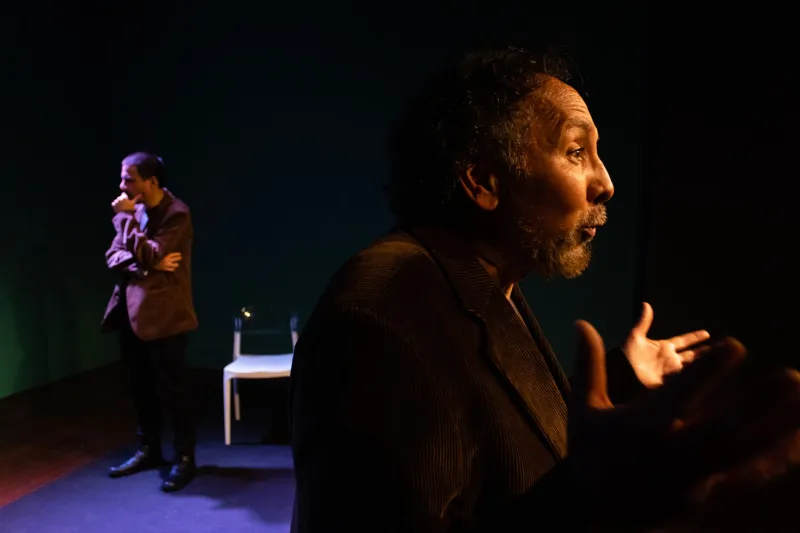
The New York theater scene, with its relative openness to new voices and unconventional narratives, has been the most welcoming space for Albanian-American artists so far. Several playwrights of Albanian descent have had readings and productions at smaller venues across the city, and the work is drawing attention.
Artan Dervishi, a playwright and director based in Queens, had his play Guri i Kuq (Red Stone) — written in both English and Albanian — performed at a Lower East Side theater last spring to sold-out houses. The play follows three generations of an Albanian family navigating land disputes, migration, and identity. It's the kind of story that doesn't fit neatly into any existing American theatrical genre, and that's exactly the point.
"I wanted to make something that Albanian-Americans would see themselves in completely," Artan says, "but that would also be totally accessible to someone who had never heard of Albania. Those goals aren't in conflict. Good storytelling is universal."
The production caught the attention of a regional theater in Philadelphia, which has expressed interest in a full run next season. It's a small step, but a meaningful one.
Film and the Indie Pathway
On the film side, the independent circuit has been the most productive avenue. Several short films made by Albanian-American directors have screened at festivals including Tribeca, SXSW, and the LA Film Festival in recent years. They tend to deal with themes of displacement, dual identity, and the particular loneliness of being between two cultures — themes that resonate far beyond the Albanian diaspora.
Klajdi Marku, a filmmaker from the Bronx, made waves with his 2022 short Dy Shtëpi (Two Homes), a quiet, observational film about a teenage Albanian-American boy trying to explain his family's traditions to his American girlfriend. Shot almost entirely in a Bronx apartment, it won the jury prize at a Brooklyn-based diaspora film festival and has since accumulated over 200,000 views on YouTube.
"I made it for $800 and a lot of favors," Klajdi says, laughing. "But the response was overwhelming. Albanians were sending it to each other all over the world. That told me there was a real hunger for this kind of story."
He's currently in pre-production on his first feature, which he's pitching to independent producers with a budget that's considerably larger than $800.
The Streaming Question
The big remaining frontier is mainstream streaming. While Albanian-American artists are making progress in theater and indie film, the leap to Netflix, Hulu, or HBO remains elusive for most. Part of that is structural — the industry still operates on networks and relationships that take years to build. Part of it is the simple reality that Albanian stories aren't yet seen as commercially obvious in the way that, say, Italian-American or Irish-American narratives have been for decades.
But there are reasons for optimism. The success of shows like Gentefied (Mexican-American), Never Have I Ever (South Asian-American), and Ramy (Egyptian-American) has demonstrated that specific, culturally rooted diaspora stories can find massive audiences. The template exists. The appetite is there.
"We just need one breakout moment," says Drita Osmani. "One show, one film that does for Albanian-Americans what My Big Fat Greek Wedding did for Greek-Americans. Once that door opens, it stays open."
Until then, the work continues — in rehearsal rooms, at film festivals, in the comment sections of YouTube videos where Albanian-Americans write things like 'finally, a story that's actually about us.' That's not nothing. In fact, it might be everything.