Show Up, Speak Up: Albanian-American Parents Are Rewriting the Rules at School Board Meetings
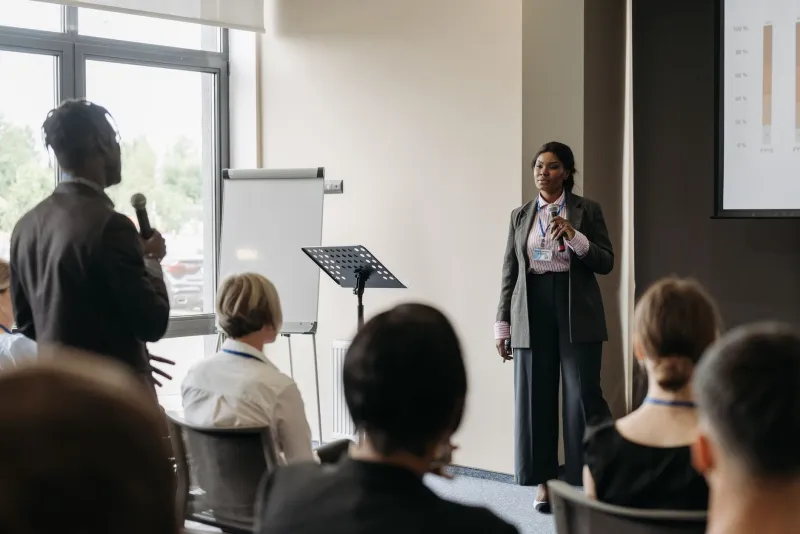
Elvira Krasniqi never planned to become the kind of person who brings a printed agenda to a school board meeting. She's a dental hygienist in suburban New Jersey, a mother of three, and by her own description, someone who grew up in a household where you didn't question authority—you worked around it.
But last spring, when her daughter came home from a seventh-grade social studies unit on European immigration and asked why Albania wasn't mentioned anywhere in the textbook, something shifted. Elvira emailed the teacher. Then the principal. Then she found herself sitting in a fluorescent-lit municipal building at 7:30 on a Tuesday night, waiting her turn at the public comment microphone.
"My mother would have thought I was crazy," she says, laughing a little. "You don't make yourself a target. That was the whole point."
Across the country, Albanian-American parents like Elvira are quietly—and sometimes not so quietly—stepping into spaces their parents never occupied: school board chambers, curriculum review committees, district diversity task forces. They're advocating for representation, pushing for heritage language programs, and in some cases, forming the kind of organized parent coalitions that can actually move the needle. It's a generational shift that says a lot about where Albanian-Americans are right now as a community.
The Silence Their Parents Kept
To understand what makes this moment significant, you have to understand what came before it.
Many Albanian-American parents who are now in their thirties and forties grew up in households shaped by the immigrant calculus of invisibility. Whether their families came from Albania, Kosovo, North Macedonia, or Montenegro, the logic was similar: keep your head down, work hard, don't make problems. Calling attention to yourself felt risky—a holdover from generations of political instability, ethnic persecution, and the particular trauma of living under regimes where visibility could get you hurt.
"There was this understanding that you assimilated," says Besnik Hoxha, a father of two in the Detroit area who has been working with a local Albanian-American parents' group for the past two years. "You didn't ask the school to acknowledge where you came from. You were just grateful to be there."
That gratitude was real and earned. But it also meant that Albanian culture, history, and language largely disappeared from the American educational experience—not just from textbooks, but from the expectations families brought to school itself.
A Different Kind of Organizing
What's emerging now isn't quite the same as the loud, confrontational parent activism you see splashed across cable news. Albanian-American parent organizing tends to be quieter, more relational, and deeply suspicious of anything that looks like grandstanding.
In northern Virginia, a loose coalition of Albanian-American families spent eighteen months working with Fairfax County school officials to get Albanian added as a heritage language option in a district language survey—a small bureaucratic change that would help the district understand how many students spoke Albanian at home. They didn't hold press conferences. They built relationships with sympathetic administrators, showed up consistently at meetings, and let the data make their argument.
"We didn't want to be a story," says one parent involved in the effort, who asked not to be named. "We just wanted to be counted."
In Massachusetts, a group of Albanian-American mothers in the Lowell area pushed their elementary school to include Albania and Kosovo in a "cultures of the world" display that ran during heritage month. It sounds minor. But for kids who had never seen their country on a classroom wall, it wasn't.
In both cases, the approach was the same: build trust slowly, avoid spectacle, and keep the goal specific enough to actually win.
The Tension at the Heart of It
There's a contradiction built into this kind of activism, and most Albanian-American parents involved in it can articulate it clearly. They want visibility for their culture and their children. But they also carry a deep cultural instinct against drawing attention to themselves.
Elvira felt it that Tuesday night at the microphone. "I kept thinking, what if I say something wrong? What if I embarrass the community? What if people think we're being difficult?"
She said her piece anyway—a two-minute ask for Albanian history to be included in the supplemental reading list for the immigration unit. The teacher agreed. It was anticlimactic in the best possible way.
But not every story ends that neatly. Some Albanian-American parents report pushback—not from school officials, but from within their own communities. There are older community members who worry that advocacy draws the wrong kind of attention, or who see these efforts as unnecessary. "We turned out fine without it" is a sentence several parents quoted back to me almost word for word.
What the Kids Are Watching
For all the complexity adults bring to these conversations, there's something simpler happening for the children at the center of it.
Besnik's daughter is twelve. She's watched her father go to school board meetings. She's seen him write emails and make phone calls and occasionally come home frustrated. She told him recently that she's proud of him—which made him laugh and then made him a little emotional when he thought about it later.
"She sees that her culture is worth fighting for," he says. "That's not something I learned until I was an adult."
That transmission—the idea that Albanian identity is something to advocate for rather than something to protect by hiding—might be the most significant thing this generation of parents is passing down. Not just Albanian language or food or music, but the posture of someone who believes they belong at the table.
Elvira's daughter, the one who asked why Albania wasn't in the textbook, has since done a class presentation on Albanian independence. She made her own poster. She brought in baklava.
"She wasn't embarrassed at all," Elvira says. "That's the difference."
Maybe that's the whole point.