When the Marriage Ends: Albanian-Americans Are Finding Their Own Language for Divorce
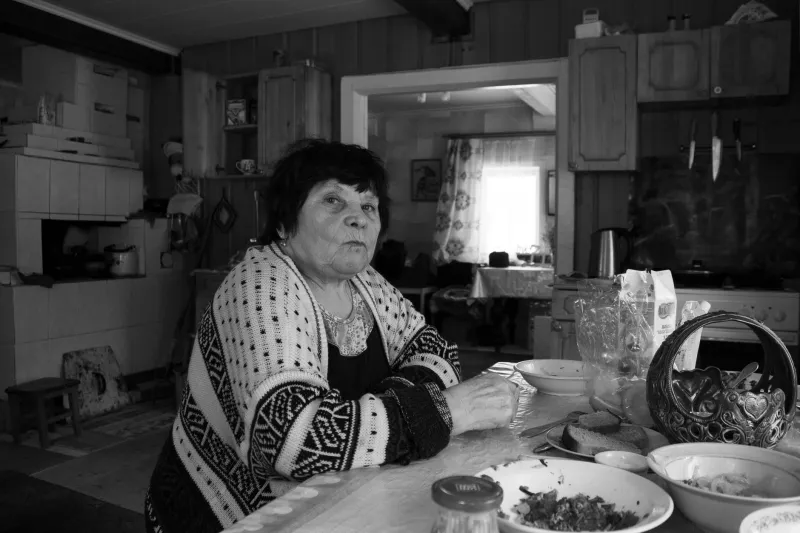
Mirela was thirty-four when her marriage ended. She had two kids, a mortgage in a suburb of Philadelphia, and a mother who didn't speak to her for six weeks.
The silence wasn't malicious. It was fear—the particular fear of a woman who had built her entire understanding of family around the idea that marriage was permanent, and who didn't have a framework for what happened when it wasn't. "She didn't know what to say," Mirela explains. "So she said nothing. And nothing felt like everything."
Eventually, her mother called. They talked. It was hard and halting and didn't resolve everything. But it was a beginning. Three years later, Mirela is remarried, her kids are adjusting, and her mother comes to Sunday dinner every week—at a table that doesn't look anything like the one she grew up imagining, but that feels, most of the time, like home.
Mirela's story is one version of a conversation happening in Albanian-American families across the country—a conversation about divorce, remarriage, blended families, and what it means to be loyal to your culture when your life doesn't follow the script it was supposed to.
The Weight of What Was Expected
To understand why this conversation is so loaded, you have to understand what Albanian cultural expectations around marriage have historically looked like—and how those expectations traveled across the ocean.
In traditional Albanian culture, marriage wasn't just a union between two people. It was an alliance between families, a social contract with obligations that extended far beyond the couple. Divorce represented a rupture in that contract—a failure that reflected on everyone. Women, in particular, bore the brunt of the stigma. A divorced woman was often seen as damaged, suspect, someone to be pitied or avoided.
Those attitudes softened considerably in Albania over the past few decades. Divorce rates have climbed. Social norms have shifted. But in diaspora communities, cultural attitudes can freeze at the moment of departure—preserved in amber while the home country moves on. Many Albanian-Americans who emigrated in the 1990s brought with them a set of values that Albania itself has since revised.
"My parents left in 1993," says Genti, a forty-one-year-old man in the Chicago area who went through a divorce five years ago. "The Albania they left doesn't really exist anymore. But that's the one they kept in their heads. And in their heads, what I did was a scandal."
A Different Kind of Loyalty
What's striking about the Albanian-Americans navigating divorce today isn't that they're rejecting their culture. Most of them would push back hard on that framing. What they're doing is more nuanced—they're trying to figure out which parts of their cultural inheritance are worth carrying and which parts were doing damage all along.
"Honor your family. Take care of your children. Don't abandon people when things get hard. Those are Albanian values and I believe in them," Mirela says. "But staying in a marriage that was making everyone miserable—that's not honoring anyone. That's just suffering."
This reframing—finding a way to honor cultural values while rejecting the specific rules built around them—shows up in a lot of these conversations. It's not a clean break. It's a negotiation.
For Genti, the negotiation was partly about his relationship with his kids. In traditional Albanian thinking, a father who leaves a marriage has failed at something fundamental. He internalized that judgment even as he intellectually rejected it. "I had to prove to myself—not to anyone else, to myself—that I could still be the father I was supposed to be, just in a different structure," he says.
He has his kids every other week. He coaches his son's soccer team. He shows up. "Maybe that's my way of being Albanian about it," he says, with a short laugh.
The Community's Slow Turn
Albanian-American communities don't change overnight, and it would be dishonest to suggest that the stigma around divorce has evaporated. In some circles, it hasn't. There are still families where a divorce is processed as a kind of collective shame, where the divorced person becomes a cautionary tale, where remarriage is treated as a further transgression.
But community leaders and clergy who work closely with Albanian-American families say they're seeing a gradual shift—not a revolution, but a softening.
"Ten years ago, I almost never had people come to me for support around divorce," says a community leader in a mid-Atlantic city who works with a large Albanian-American population and asked to speak generally. "Now it's a regular conversation. People are asking for help processing it rather than just hiding it."
Some of that shift is generational. The second-generation Albanian-Americans who are now in their thirties and forties grew up watching American peers navigate divorce with far less stigma. They've seen blended families work. They've absorbed, through culture and education and lived experience, a different set of assumptions about what family can look like.
Some of it is also the women. Albanian-American women who are economically independent, professionally established, and embedded in networks beyond their immediate community have more options than previous generations did—and more willingness to exercise them.
Blended Families, New Scripts
Perhaps the most uncharted territory is the blended family—the remarried couple with kids from previous marriages trying to figure out how to build something coherent out of complicated pieces.
Mirela's household includes her two kids, her new husband's daughter from his first marriage, and a rotating cast of grandparents and extended family members who are all still figuring out where they fit. It's chaotic and loving and occasionally exhausting.
"There's no Albanian word for 'stepmom' that doesn't carry baggage," she says. "So we just call her Aunt Mirela's husband's daughter. Which is a mouthful. But it's ours."
That improvisation—making up language for things that don't have names yet—might be the most honest description of what Albanian-Americans are doing around divorce right now. There's no template. The old one doesn't fit. The new one hasn't been written.
So they're writing it themselves, one difficult conversation at a time, one Sunday dinner at a time, in a language that's part Albanian and part American and entirely their own.