Something Borrowed, Something Shqip: The Albanian-American Wedding Business Is Booming
The average Albanian wedding in America doesn't start on a Saturday and end Sunday morning. It starts with debates — sometimes months in advance — about whether the groom's family is bringing enough guests, whether the music will be live, whether the bride's dress is too American or not American enough. And somewhere in the middle of all that beautiful chaos, there's usually an Albanian-American entrepreneur quietly making it all happen.
The Albanian-American wedding industry has grown into something that's genuinely hard to ignore. From event planners and floral designers to catering operations and custom embroidery studios, second-generation Albanian-Americans are building real businesses out of a very specific cultural fluency — and the numbers are starting to reflect it.
The Market Nobody Was Talking About
For a long time, Albanian families in the US made do with whatever vendors were available locally, often piecing together celebrations from Italian caterers, generic DJ services, and whoever happened to have a large enough banquet hall in the tri-state area. The cultural specifics — the iso-polyphony playlists, the specific cuts of byrek for the reception table, the velvet-trimmed traditional costumes for the children — were DIY projects handled by aunts and neighbors.
Then something shifted. As the children of 1990s and early 2000s Albanian immigrants grew up, got educated, and started entering the workforce, a few of them looked at their own family weddings and saw a gap in the market. They knew what Albanian families actually wanted. They also knew how to build a business.
Era Kelmendi, a wedding planner based in northern New Jersey, started her company after planning her own wedding and realizing that no vendor she hired truly understood what she was asking for. "I kept having to explain everything from scratch," she says. "Why we needed two separate receiving lines. Why the music had to transition a specific way. Why the parents' table placement wasn't just a preference — it was a statement." After her wedding, three relatives immediately asked if she'd plan theirs. She said yes, and never looked back.
Today her client list spans Albanian-American families from New Jersey, New York, Connecticut, and as far as Michigan and Illinois. Her average wedding budget has climbed steadily — she won't share exact figures, but she describes her typical engagement as "solidly in the five figures, sometimes well beyond."
Bridging Two Worlds, One Seating Chart at a Time
What makes the Albanian-American wedding market distinct isn't just scale — it's complexity. These events often have to satisfy two very different visions simultaneously.
On one side, you have the parents and grandparents, many of whom immigrated with vivid memories of how weddings were done back home. They want the lahuta player if possible, the specific sequence of toasts, the women dressed in xhubleta at some point in the evening, the table loaded with specific dishes that signal abundance and respect. Cutting corners on these elements isn't just a stylistic choice — it reads as disrespect.
On the other side, you have the couple themselves, often fully Americanized in their tastes, who've spent time on Instagram and wedding blogs and want something that feels elevated, modern, and photogenic. They're not trying to erase their heritage — far from it — but they want it presented through a contemporary lens.
Navigating that tension is exactly where Albanian-American vendors earn their fee.
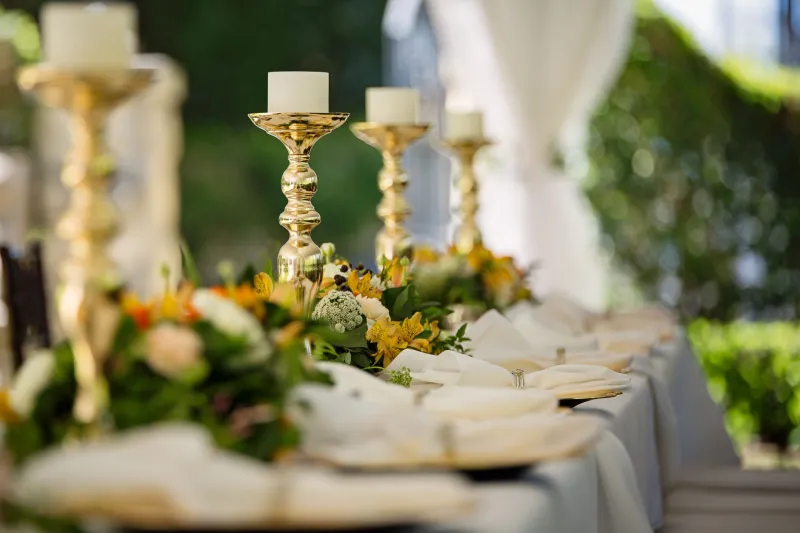
Blerta Gashi, who runs a floral and décor studio in the Bronx, describes her work as "cultural translation with flower arrangements." She's learned to build proposals that layer traditional symbolism into modern aesthetics — pomegranates worked into centerpieces (a nod to fertility and abundance in Albanian custom), deep reds and golds that feel simultaneously traditional and on-trend, embroidered table runners that reference regional folk patterns without looking like a museum display. "The parents look at it and feel proud," she says. "The couple posts it on Instagram and gets a thousand likes. That's the goal."
The Economics of Diaspora Demand
Serving a diaspora community comes with specific economic realities. Albanian-American families tend to have large guest lists — 200 guests is considered modest in many circles, and 400 to 500 isn't unheard of. That scale drives up revenue potential but also complexity.
Vendors who've built their reputations within the community benefit enormously from word-of-mouth. In a tight-knit diaspora, a single spectacular wedding can generate six referrals. A single visible failure — a caterer who ran out of food, a DJ who played the wrong music at the wrong moment — can end a career almost as quickly.
That social pressure cuts both ways. It creates high standards but also a fiercely loyal customer base. Several Albanian-American wedding entrepreneurs describe clients who've hired them for a wedding, then a christening, then a graduation party, then a second sibling's wedding. "Once you're in with a family, you're in," says one New York-based photographer who asked not to be named. "These aren't one-time clients. They're relationships."
Some entrepreneurs have scaled their cultural expertise into broader service offerings. A few catering operations that started serving Albanian weddings now offer packages to the wider Eastern European diaspora community. Others have moved into consulting, helping non-Albanian vendors understand how to serve the community without fumbling the specifics.
The Challenges Nobody Advertises
It's not all centerpieces and champagne toasts. Albanian-American wedding vendors face some genuinely thorny challenges.
Negotiating between generations can get emotionally charged in ways that go beyond typical client management. When a grandmother objects to the bride's dress neckline, that's not just a fashion disagreement — it's a conversation loaded with values about modesty, family honor, and community perception. Vendors often find themselves functioning as informal mediators, which isn't exactly in the contract.
There's also the question of pricing. Albanian-American communities, like many immigrant communities, carry complicated relationships with money and perceived extravagance. Charging premium rates — even when fully justified — can sometimes generate pushback from clients who feel that a fellow Albanian should offer a "family deal." Several entrepreneurs mentioned this dynamic as one of the harder aspects of working within their own community.
"There's a tension between being part of the community and running a real business," says Kelmendi. "I love my clients. I also have a team to pay and a company to grow. Finding that balance took years."
Building Something That Lasts
What's striking about this generation of Albanian-American wedding entrepreneurs is how intentional they are about legacy — not just their businesses, but what those businesses represent.
Many describe their work as a form of cultural preservation. Every wedding they plan that incorporates traditional elements is a wedding where those traditions survive into another generation. Every piece of embroidered fabric, every folk song worked into a reception playlist, every dish that connects a bride or groom to a village their grandparents left behind — that's continuity.
"I'm not just planning parties," says Gashi. "I'm helping people figure out who they are on one of the biggest days of their lives. That happens to be really good for business, too."
The Albanian-American wedding industry is still young enough that there's no trade association, no industry conference, no formal network. But the entrepreneurs building it are connected anyway — through family ties, through community events, through Instagram DMs at midnight when someone needs a referral fast.
They're doing what Albanian-Americans have always done: building something real from the materials at hand, making it work across two cultures at once, and making it look effortless from the outside.
The secret, if you ask them, is that it's never effortless. It's just deeply, specifically theirs.