Roots in Red Clay: Albanian-Americans Are Growing the Old Country in the American South
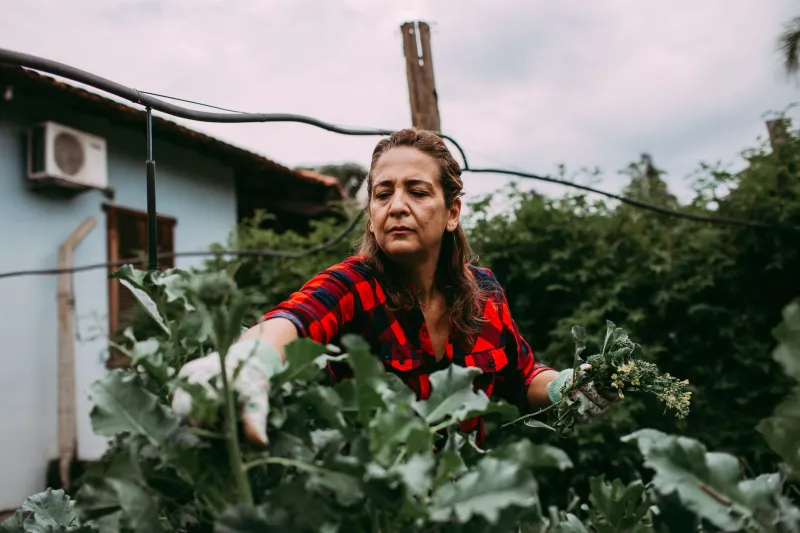
The first thing Nora Shehu planted when she and her husband bought their five acres outside Gainesville, Georgia, was a fig tree.
Not because figs are particularly rare in the American South. You can find them at any farmers market. But the variety she planted—a cutting her uncle had smuggled out of Albania in a damp paper towel tucked inside a sock, then propagated for twenty years in his Queens apartment—wasn't something she could buy anywhere. It was the same fig her grandmother had grown in their village outside Shkodër. The same one she'd eaten as a child before her family left.
"When it finally fruited, I cried," Nora says, standing in her garden on a warm October morning. "I know that sounds dramatic. But it tasted like something I thought was gone."
Nora isn't alone. Across Georgia, North Carolina, Alabama, and other parts of the South where Albanian-American communities have quietly settled over the past two decades, a small but growing number of families are doing something similar—cultivating traditional Albanian crops, herbs, and agricultural varieties in American soil. Some are doing it on a few backyard acres. Others have scaled up into small farm operations that supply Albanian restaurants and diaspora families across the region.
All of them are doing it for reasons that go well beyond gardening.
Why the South?
It's a fair question. When most people think of Albanian-American communities, they think New York, New Jersey, Michigan, Massachusetts—the classic northeastern corridor. And those communities are real and large and well-established.
But over the past fifteen to twenty years, a quieter migration has been happening. Albanian-American families, many of them second-generation and looking for more space and lower costs, have been drifting south. The Carolinas, Georgia, and Tennessee have drawn families who can afford land they'd never touch in the tristate area.
And land, it turns out, is what you need to grow the things you remember.
"In an apartment in the Bronx, you can grow herbs in a window box," says Artan Mehmeti, who farms a small plot outside Asheville, North Carolina. "Down here, I can grow everything."
Artan grows several varieties of Albanian peppers, a sprawling patch of wild mountain herbs he calls "the medicine garden," and rows of a particular climbing bean his mother brought from Kosovo in seed form years ago. He's also been experimenting with growing qumështore—a flowering plant used in traditional Albanian cooking—which he'd never been able to source fresh in the United States.
The Supply Chain Nobody Knew They Needed
What started as personal projects for many of these growers has evolved into something more communal. As Albanian-owned restaurants have expanded in cities like Atlanta and Charlotte, and as diaspora families have spread further from the old urban centers, there's been a growing demand for ingredients that simply don't exist in conventional supply chains.
Nora now supplies several Atlanta-area Albanian and Balkan restaurants with fresh herbs, specialty peppers, and seasonal vegetables that chefs couldn't reliably source anywhere else. She's not running a large commercial operation—she's careful to say that—but she's built a steady network of buyers who treat her like a lifeline.
"A chef called me last summer because he needed fresh gjetra," she says, referring to a type of wild leek used in traditional Albanian dishes. "He'd been trying to find it for two years. I had it growing right here."
Artan has started doing something similar, selling at a regional farmers market and taking special orders from families who learned about him through word of mouth in the local Albanian community. He's not getting rich. But he's not trying to.
"This isn't really a business plan," he says, a little sheepishly. "It's more like a calling."
The Generation Gap in the Garden
The most interesting conversations happening on these farms aren't between growers and chefs. They're between parents and children.
For Nora's kids—teenagers who grew up in Georgia, who speak English without an accent and whose cultural connection to Albania is real but sometimes abstract—the garden has become an unexpected classroom. Her fourteen-year-old son, who initially showed zero interest in anything involving soil, spent a full afternoon last summer learning how to cure and save seeds from her Albanian pepper plants.
"He asked me how Grandma knew which ones to save," Nora says. "And I realized I didn't fully know. So we called her. We video-called her in Albania for an hour, talking about seeds."
That phone call—three generations on a screen, talking about seeds—is the kind of thing that's hard to manufacture and impossible to replicate through a heritage festival or a language class. It's cultural transmission happening in real time, rooted in something literal.
Artan's daughter, who is nine, can already identify most of the herbs in the medicine garden by smell. She knows which ones her grandmother used for headaches and which ones went into the lamb stew. She doesn't know she's learning ethnobotany. She thinks she's just helping her dad.
Something Worth Preserving
There's a quiet urgency underneath all of this that growers are reluctant to say out loud but clearly feel.
Many of the seed varieties being grown on these small Southern farms exist nowhere in any official seed bank. They were passed between families, carried across borders in coat pockets and checked luggage, propagated in apartments and backyards for decades. If the people who hold them stop growing them, they're gone.
"I think about that," Nora says. She's looking at the fig tree now. It's heavy with fruit, late in the season. "My grandmother didn't know she was preserving something. She just grew what she grew. But we know. So we don't really have an excuse not to."
The red clay of Georgia is nothing like the limestone soil of the Albanian highlands. The humidity is different. The light is different. But things grow anyway—stubborn, adapted, alive.
Just like the people who planted them.